Banbury Stamp Society kicked off its new season on Tuesday, 7th October 2025, to hear Giles de Boulay, who returned to give another fascinating display on the history of Danzig; now known as Gdańsk, as told through stamps and postal history.
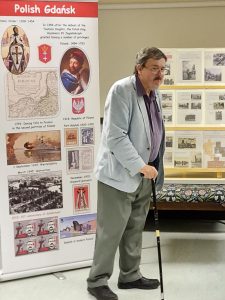
Giles opening observation was, “Danzig is a history of change – of one administration to another”, a theme that shaped the presentation. He traced the city’s turbulent story from its political beginnings under the Teutonic Order (1308–1454), through to Polish rule from 1454–1793, and later its transformation under Prussian, Free City, German, Russian, and modern Polish control.
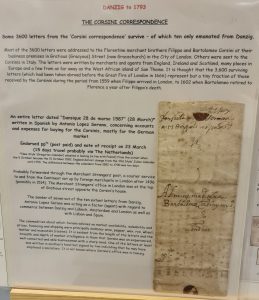
The first half focused on Danzig as an independent city under the Polish rule, when its mercantile strength made it one of the wealthiest ports of the Baltic. Giles showed a series of attractive covers and cancellations illustrating the city’s role as a trading hub, noting how postal markings and official seals reflected its cosmopolitan commercial culture.
Moving forward to the inter-war years, Giles examined the complex postal arrangements following the Treaty of Versailles, when Danzig was declared a Free City under the protection of the League of Nations, despite a predominantly German population. Poland was granted postal rights within the territory. Giles explained the friction this created between the Polish and Free City authorities.
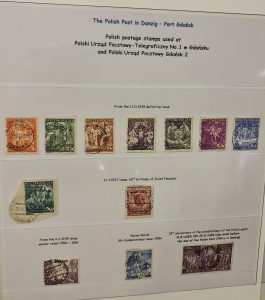
On 5th January 1925, the Poles opened their own post office and installed red post boxes exclusively for mail to Poland, provoking protests and acts of rebellion among the Danzig population who had their own parallel postal system.
The stamps used by the Polish Post Office were Polish definitives overprinted “Free City of Danzig”, and Giles illustrated how mail addressed “Danzig” was handled by the Free City postal system, whereas that marked “Gdańsk” was routed through the Polish Post. Numerous examples of these intriguing postal distinctions were shown.
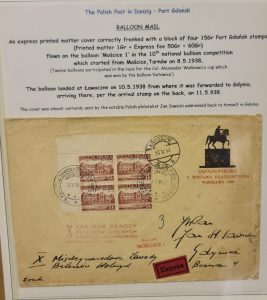
The talk was enlivened by a number of charming anecdotes, and fascinating philatelic material, including ‘balloon mail’ from the city’s popular balloon races.
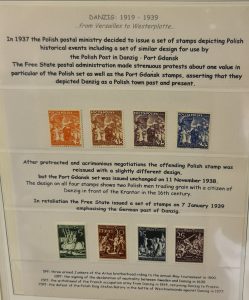
A “stamp war” erupted in 1937, when competing sets of stamps depicting the same designs—one set in Polish, the other in German— were issued, illustrating how philately mirrored political tension.
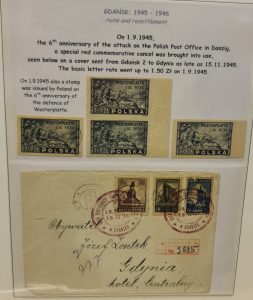
Attention then turned to 1st September 1939, when the first shots of the Second World War were fired into Gdańsk from a German battleship. The siege of the Polish Post Office, whose defenders held out for seven days, was an incredible story.
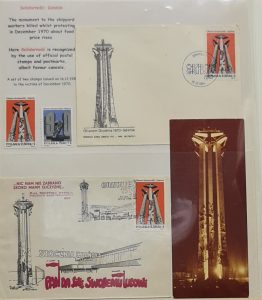
The post-war section of the display showed mail under Russian control and the reconstruction of the old city under Polish administration. German names were systematically erased from postcards, censorship markings reappeared, and the city reverted permanently to the name Gdańsk, using Polish general stamp issues. Giles concluded with examples from the Solidarity movement of the 1980s, when martial law again brought in mail censorship.
The next meeting of the Banbury Stamp Society will be held on Tuesday, 21st October 2025, at 7:30pm at Hanwell Fields Community Centre. The Banbury Stamp Society is on-line at ‘www.banburystampsociety.co.uk’, or contact John Davies on 01295 255831.