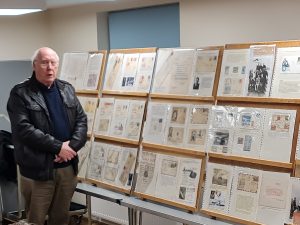
Members were treated to a fascinating and wide-ranging display by Alan Godfrey on the extraordinary life of Sir George Hubert Wilkins (1888–1958), a man whose career spanned early cinema, pioneering aviation, polar exploration, and wartime intelligence work.
Born in 1888 in South Australia, the youngest of thirteen children, Wilkins moved with his family to Adelaide in 1905. Initially studying music, his imagination was captured by early silent films. Determined to be involved, he joined a travelling “tent cinema,” working on electrics, filming, acting, and photography. An opportunity later arose in London, and with characteristic audacity he stowed away on a ship to reach Europe—after first mistakenly ending up in Tunis.
In London he worked for the News Chronicle as a photographer and cinematographer. Aviation pioneer Claude Grahame-White taught him to fly (though he likely never obtained a licence due to colour blindness), and Wilkins became one of the first to film from an aircraft. During the Balkan War he filmed from the air over the Turkish front lines—an unprecedented achievement. Arrested by the Turks on suspicion of espionage and reportedly placed before a firing squad three times, he refused to confess and was eventually released.
In 1913 he joined a Canadian Arctic expedition, an ill-fated venture marked by poor organisation. While still away he learned of his father’s death and the outbreak of the First World War. Returning to Australia, he enlisted and was eventually sent to France as a photographer with Australian forces. Promoted to Captain, he was awarded the Military Cross and Bar for bravery, including rescuing soldiers under fire.
After the war he participated in the England-to-Australia Air Race as a navigator, surviving a crash in Crete. In 1920 he joined a financially precarious Antarctic expedition, and in 1921 became part of Shackleton’s final expedition aboard the Quest, though mechanical troubles curtailed progress.
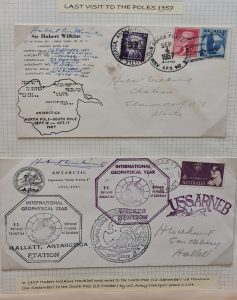
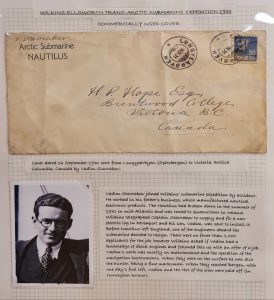
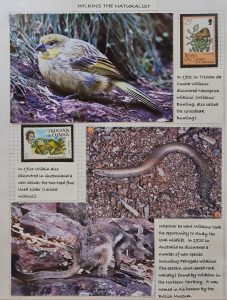
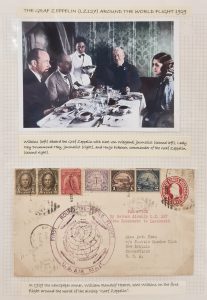
Wilkins later returned to Australia to film wildlife, but his criticism of government treatment of Aboriginal peoples led to him being shunned at home. Undeterred, he crossed the Arctic by plane in 1926 after several attempts, earning a knighthood from King George V. He continued Antarctic exploration, participated in the 1929 round-the-world flight of the Graf Zeppelin, and in 1931 attempted to navigate beneath Arctic ice in a refurbished First World War submarine, renamed Nautilus. Although the voyage achieved only limited success, it marked the first submarine operation under polar ice. Philatelic mail carried on the expedition adds a notable postal history dimension.
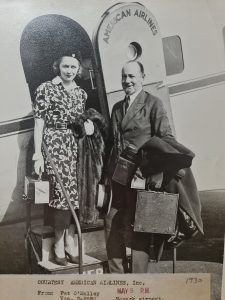
Financed at times by William Randolph Hearst and later by Lincoln Ellsworth, Wilkins managed further Antarctic flights, including expeditions involving the vessel later known as the Wyatt Earp. He flew on the Hindenburg in 1936, served in wartime technical roles during the Second World War, and undertook intelligence work in Japan. Even in later life he remained active in polar research, visiting nuclear submarines including USS Skate, which scattered his ashes at the North Pole in 1959. His wife’s ashes were similarly committed there in 1975.
Alan’s display highlighted Wilkins as a truly global pioneer—arguably one of the last great all-round explorers of the modern age.
The next meeting of the Banbury Stamp Society will be held on Tuesday, 4rd March 2026, at 7:30pm at Jubilee Park Hall, Bloxham. The Banbury Stamp Society is on-line at
‘www.banburystampsociety.co.uk’, or contact John Davies on 01295 255831