The meeting was devoted to an engaging and wide-ranging display entitled Christmas Philately, introduced by Julian, who set the scene with a brief historical context. He began by referencing Henry Cole, designer of the world’s first Christmas card, noting that an example had sold recently at Cavendish Auctions for approximately £13,000. Julian then moved on to postal innovation at the turn of the 20th century, explaining how in 1901 John Phillips, the Manchester Postmaster (or Surveyor), sought to encourage the public to post early for Christmas. As a result, he was permitted to trial one of the earliest special Christmas postmarks, specifically for Christmas Day delivery.
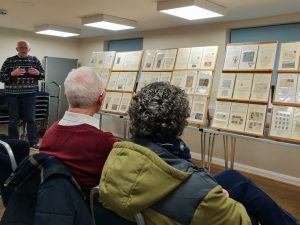
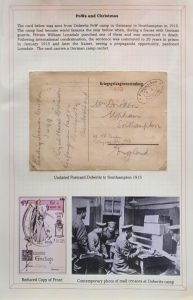
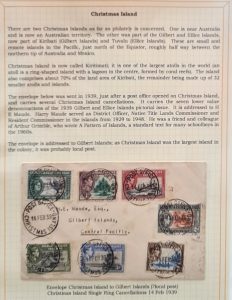
The display then turned to First World War Christmas material, including a notable selection of Christmas cards sent by and to Prisoners of War, illustrating both the emotional and postal significance of seasonal correspondence during wartime. A fitting interlude followed with Christmas Island, shown through attractive letters, cards, and covers. This was complemented by a discussion of various countries and issues laying claim to the world’s first Christmas stamps, highlighting how different postal administrations approached the concept.
Julian also explained the postal arrangements for British Forces stationed in Egypt, where an agreement required all military mail to pass through the Egyptian postal system so that Egypt received the revenue. These items were counter stamped with “British Forces in Egypt” Cinderella’s, examples of which were displayed.
Part II – Christmas Day Postal Usage
The second part of the talk focused specifically on items postmarked on 25 December. Julian’s earliest exhibit was a remarkable letter dated 25 December 1704, bearing a Bishop Mark, addressed to Dice Quay, Lower Thames Street, London, to John Morre, wine merchant, and posted from Lincolnshire. Other early examples followed, including letters with distinctive evening markings such as “at 7 pm”, and covers showing multiple postal rates, some rising as high as 11d.
Julian explained how political intervention affected postal charges when toll road owners objected to mail coaches using their roads free of charge. Although mail coaches were effectively the heavy goods vehicles of their day, tolls were only permitted in Scotland, where relatively few toll roads existed, resulting in an additional ½d charge.
The subject of Free Fronts was also discussed, with examples illustrating how the privilege was frequently abused.
Among the Victorian material shown were two Penny Black covers with 25th December date stamps, alongside a Mulready cover dated 24th December.
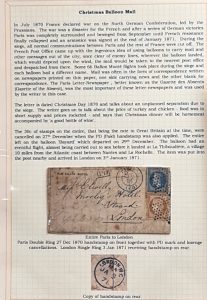
A particularly evocative section concerned the Siege of Paris (1870). During the Prussian occupation, Parisians relied on balloon mail, sent out under cover of darkness. Julian displayed a letter bearing a 27th December postmark, but written on Christmas Day, describing a Christmas meal consisting of horse meat.
Julian’s personal favourite item was a complex postage due cover dated Christmas Day, which travelled Berlin → London → United States, before being redirected again in an effort to trace a touring actor who had failed to pay his telephone bill.
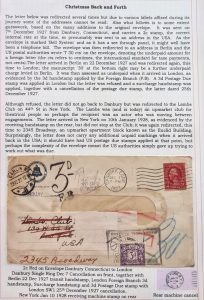
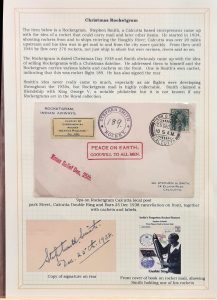
The display concluded with a striking example of rocket mail (or “rocketgram”), sent by Stephen Smith to Calcutta on Christmas Day 1938, providing a fittingly unusual finale to the talk.
The Society extended its thanks to Julian for an engaging and stimulating evening.
The next meeting of the Banbury Stamp Society will be held on Tuesday, 6th January 2026, at 7:30pm at our temporary home, Jubilee Park Hall, Bloxham OX15 4NJ. The Banbury Stamp Society is on-line at ‘www.banburystampsociety.co.uk’, or contact John Davies on 01295 255831.