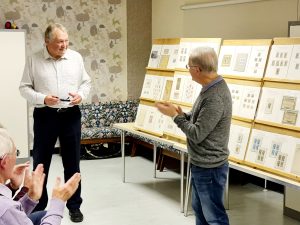
Members of the Banbury Stamp Society were treated to a fascinating and highly specialised display by Chris Harman, a leading authority and contributor to the Stanley Gibbons catalogues. His presentation, titled “Cinderella Stamps – Back of the Book Items”, offered a broad exploration of those intriguing non-postal issues that fall outside the mainstream stamp listings but remain a vital part of the philatelic story.
Chris opened his display with examples of non-key plate Revenue stamps, explaining their distinction from standard issues. Of particular note were several 19th-century Matrimonial Court Divorce stamps, believed to be among the very few surviving examples—so rare that few in the audience had even heard of them, let alone seen them.
He went on to show Perforation 12½ Cinderellas, produced using a De La Rue perforator normally reserved for colonial issues. These scarce items illustrated how the firm also applied its expertise to small private or commemorative printings.
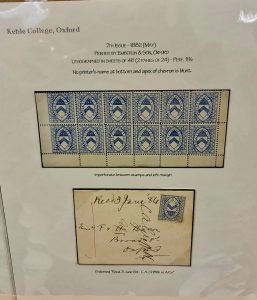
A highlight of the evening was the section devoted to College Stamps. Chris explained that both Oxford and Cambridge Universities held a long-standing exemption from the Post Office monopoly, dating back to medieval times. The first Oxford issue, from Keble College, included an embossed tête-bêche pair—an acknowledged rarity. Complementing these were colour trials, college stationery, and a delightful Keble College cover addressed to Mr Pain, bootmaker of Oxford, in which an undergraduate protested against charges for a pair of bespoke boots and threatened to “go elsewhere.”
Chris then moved to local delivery Cinderellas—labels issued by town carriage companies operating independent mail services, notably in the industrial north. Early examples included the Bristol Parcel Delivery Company and Marshall Brothers of Leeds, with original photographs used for their designs also on display.
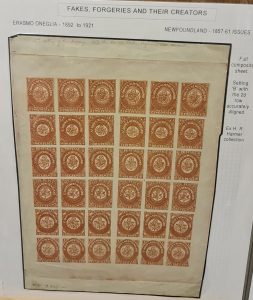
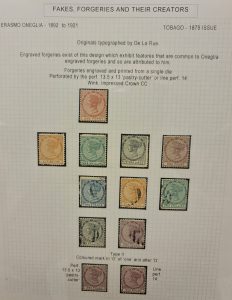
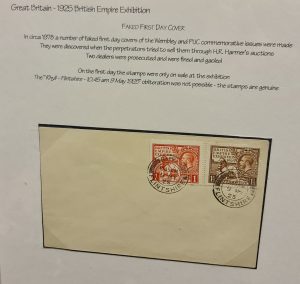
The final sections focused on Airmail Cinderellas and Exhibition and Forgeries material. Early private airmail issues were shown, including Provisional Airways colour trials and die proofs—companies licensed to carry letters under the classification of “trains.” Items relating to the Hyde Park Hotel, British Empire Exhibition (1924–25), and Stanley Gibbons’ own colour-guide labels followed. Chris discussed notable 1970s forgeries of exhibition first day covers, which led to the imprisonment of two dealers.
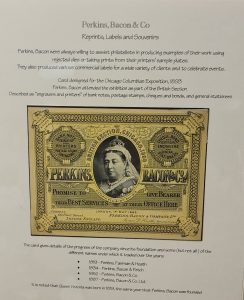
Concluding with Perkins Bacon recess-printed advertising labels—notably The Regiment newspaper proofs in green—and First World War propaganda labels, Chris explored the world of forgers such as Erasmo Oneglia, whose deceptive reproductions of British West Indies, Canadian, and Newfoundland issues were often indistinguishable from genuine stamps except in full sheets.
The audience expressed warm appreciation for a remarkable evening of scholarship, rarity, and humour, presented with clarity and enthusiasm by Chris Harman.
The next meeting of the Banbury Stamp Society will take place on Tuesday, 4th November 2025 at 7:30 pm, at the new temporary venue: Jubilee Park Hall, Barley Close, Bloxham OX15 4NJ.