Members of Banbury Stamp Society enjoyed an excellent presentation and display on Austria, given by club member Malcolm Moodie, covering a century of political and philatelic history from 1850 to 1945. Malcolm began by outlining the dramatic territorial changes of the Austrian Empire. In 1850, Austria was the largest mainland empire in Europe, covering around three-quarters of a million square kilometres. By 1872 the empire had already halved in size, and following the First World War only about 12% of the original territory remained, broadly forming modern Austria.

Austria’s first postage stamps appeared in 1850, ten years after Great Britain. Like early British issues, these stamps bore no country name, a practice that continued until 1888, when UPU regulations required national identification. Malcolm demonstrated the complexity of these early issues, particularly those of Lombardy and Venetia, territories within the Austro-Hungarian Empire. While many catalogues and collectors treat these as “back of the book” material, Austrian catalogues regard them as core issues. Numerous type variations exist, and Malcolm noted two famous gaps in his collection — items catalogued at around £200,000 each, which he has never even seen offered for sale.
In 1867, the first stamp issues partially unique to Hungary appeared, showing clear differences from those of Austria. This led into the creation of the Dual Monarchy in 1872, a political settlement closely associated with Empress Elisabeth, wife of Emperor Franz Joseph. The presentation then followed the increasingly tragic fortunes of the imperial family. The heir, Crown Prince Rudolf, married Princess Stéphanie of Belgium but died in 1889 in the Mayerling incident, found dead alongside his mistress. Empress Elisabeth herself was later assassinated, and Malcolm illustrated this period with moving mourning covers.
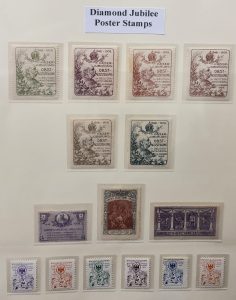

More celebratory material included Diamond Jubilee stamps and postcards, the latter printed in eight languages, reflecting the linguistic diversity of the empire. Malcolm contrasted these with postcards produced outside Austria-Hungary, which were often far less respectful and sometimes openly mocking.
Philatelic highlights from the early 20th century included Austria’s first airmail issue, rarely used South Tyrol parcel control labels, and material from Bosnia and Herzegovina. This led naturally to the assassination of Archduke Franz Ferdinand in Sarajevo on 28 June 1914 by Gavrilo Princip, an event that triggered the First World War. As Franz Ferdinand’s daughter was ineligible to inherit, the succession passed to a distant relative.
After the war, Emperor Charles attempted to preserve what remained of the empire, but the task proved impossible. He was exiled to Madeira, was deeply religious, and was later beatified. Malcolm showed how post-war treaties led to new stamp issues, including overprinted Austrian stamps incorporating German, reflecting popular sentiment for union with Germany, before the emergence of the First Austrian Republic. Later sections covered mourning stamps for an Austrian Chancellor Dollfuss assassinated by a Nazi group, railway stamps commemorating the locomotive *Austria* designed by Robert Stephenson, and the period after the Anschluss, when Austrian philatelic material continued to be produced despite German control of the postal system.
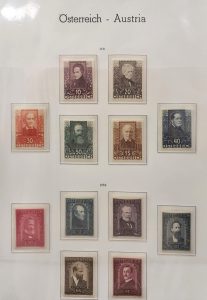
The evening provided a compelling demonstration of how Austrian stamps vividly reflect the rise, fragmentation, and eventual collapse of a great European empire.
The next meeting of the Banbury Stamp Society will be held on Tuesday, 3rd February 2026, at 7:30pm at Jubilee Park Hall, Bloxham. The Banbury Stamp Society is on-line at
‘www.banburystampsociety.co.uk’, or contact John Davies on 01295 255831.